
October 28, 2021
Inrush Current: The Power and Pitfalls of Navigating a Battery Energy Storage System
This is a guest blog post from Pine Gate Renewables. Connect with Pine Gate Renewables at #ESACon21 in Phoenix, AZ, December 1-3. Registration is open!
As battery energy storage hurdles its way towards becoming a larger part of our electricity mix there are a lot of things to consider ensuring a project is engineered for safety and performance. When making decisions about system design basis, it’s important to first understand the nuances of how battery storage works and the factors that affect system performance over the life of the project.
Take inrush current, for example.
Inrush current is an instantaneous burst of current that is drawn by a source of power when equipment is turned on. This is a result of high initial currents required to charge capacitors, inductors, or transformers, in general.
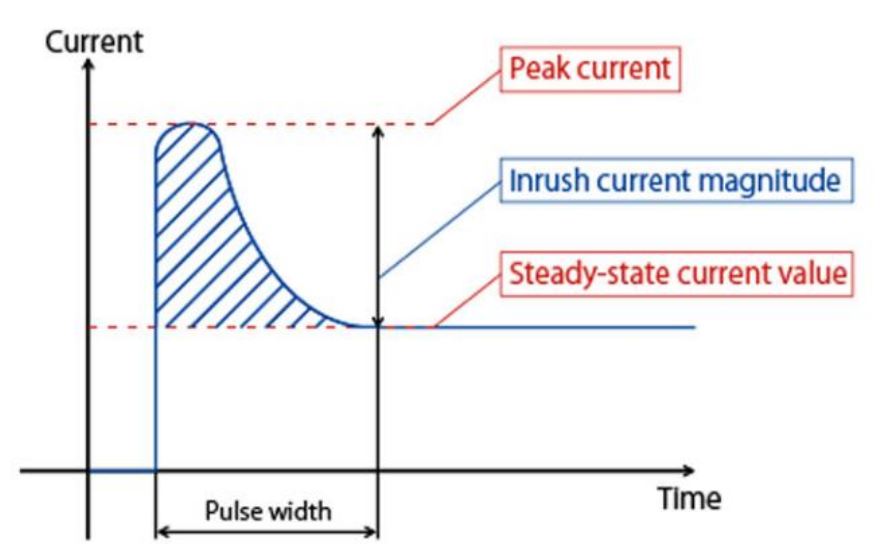
Capacitance and inductance have diverging effects on power quality and power production. Capacitance, which is measured in Farads, is the ability to store energy in the form of an electric field, whereas inductance, measured in Henries, is the ability to store energy in the form of a magnetic field. Capacitors initially have zero voltage, and then have a voltage drop or potential difference that increases exponentially after a voltage source is connected. Inductors on the other hand, initially have zero current and current flow increases exponentially when a voltage source is connected. To summarize capacitance and inductance, both influence the total impedance are inherent in power systems and serve an important role in regulating power quality.
Transformers on the other hand, are passive electrical devices or transducers that transform electrical energy from one circuit to another through the process of electromagnetic induction. It is commonly used to step-up or step-down voltage levels between circuits in the power system industry. Transformers work on the simple principle of mutual induction that allow a path for electrical energy to be transferred and transduced from one circuit to another.

It is no surprise that interconnecting utilities have concerns about power quality as that can result in instability of the grid. To ensure the integrity of the grid and reliable service, utilities need to ensure that all interconnecting power systems can provide power and ancillary services that mitigate the loss of load in their network.
Power quality issues related to inrush current can be a big obstacle in the interconnection process since battery energy storage systems, especially AC coupled, can increase the chances of higher sustained inrush at the point of interconnect due to the presence of additional transformers. For a distributed generation facility (let’s say solar AC-coupled with storage), the distribution grid can experience a rapid reduction in voltage due to a sudden surge in current when too many transformers get energized at the same time. This surge and rapid voltage differential can lead to equipment damage for customers downstream and requires tactical mitigation strategies for the system to operate in compliance with IEEE standards.
One simple way of mitigating inrush and the cascading effects it has on power quality is to have the appropriate control systems and adequate switchgear and protection mechanisms in place. For example, by sequencing the Energy
Management System (EMS) and Power Plant Controller (PPC), one can energize a transformer upon grid restoration, whilst including a timed delay for energization on other transformers — just enough to ensure that the point of interconnect does not realize sudden changes in voltage or current.
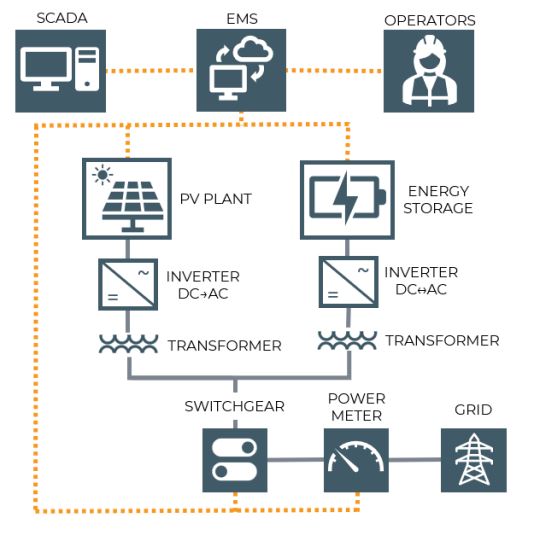
EMS serves the purpose of regulating power flow (voltage and current as well) within the project itself. It is responsible for optimal charging and discharging of the BESS and serves as an interface to the Battery Management System (BMS). The Power Plant Controller (PPC) serves as the interface between the project as a whole and the utility’s network. It is imperative that the BMS, EMS and PPC have a way to communicate with each other effectively.

Not accounting for power quality can result in high interconnection costs, potentially delaying or killing projects altogether. It is therefore imperative to have relevant control strategies in place, with defensible engineering and modeling assumptions that can help alleviate concerns around power quality and operate these assets within acceptable electrical standards. The same issue could have a cascading effect on reporting requirements and the Investment Tax Credit (ITC), which is a critical source of financing for both residential, commercial and utility-scale projects across the country.
To learn more about an actual project that faced a similar challenge, check out the Grissom Solar project in Enfield, NC, a 6.9 MW PV + 5 MW/10 MWh project developed by Pine Gate Renewables for Halifax EMC. Click here to learn more.
About the author:
Raafe Khan leads energy storage development and integration strategy across North America and provides insight on value creation leveraging energy storage and demand response. Since joining Pine Gate Renewables in 2020, he has executed more than 124 MWh of energy storage capacity projects and is currently spearheading a development pipeline of more than 2.5 GW/12 GWh over the next 3-5 years.

